How to use ChatGPT to learn Hydrology - Part I: configuration, context and useful prompts
Estimated reading and practice time: 15-25 minutes.
Why this series of tutorials?
Preparing university students today for their future professional practice is unusually challenging because we cannot know precisely what Artificial Intelligence systems will be able to do in a few years. The capabilities of generative models are evolving rapidly, barriers to access are falling, and the range of tasks that can be automated is changing. Teaching only how to operate the current version of ChatGPT therefore has limited long-term value: the tools will change, but engineers will still need to understand a problem, judge the quality of an answer, verify evidence, detect errors and make responsible decisions.
Recent discussion in higher education points in the same direction. AI can broaden access to explanations, feedback and personalised learning, but it can also foster dependence, superficial learning and reduced exercise of critical thinking when it replaces the student’s own cognitive effort (Vieriu & Petrea, 2025). The challenge is therefore not simply to adopt AI more quickly, but to decide what it should be used for and what kind of learning we want it to support (Baron, 2026). Likewise, recent analyses argue that higher education should strengthen capacities such as critical thinking, adaptability, curiosity and lifelong learning (Woon, 2025), and that many of the decisions posed by AI are fundamentally pedagogical before they are technological (Tobor & Sommer, 2026).
For that reason, the purpose of this three-part series is not to teach you how to obtain answers more quickly. It is to help you use generative AI to understand Hydrology more deeply, practise more effectively, identify what you still do not understand, and develop the autonomy required to solve unfamiliar problems. In short:
Use AI to increase learning, not to avoid the process of learning.
ChatGPT can help you learn Hydrology, or it can help you avoid learning it. The difference depends mainly on how you use it.
In IIO422-Hydrology, obtaining the correct numerical answer is not enough. The course expects you to analyse hydrological processes, quantify variables, work probabilistically, interpret results, detect errors and justify engineering decisions. Generative AI is explicitly permitted as a learning and computational support tool outside assessments, but its use must be critical, verifiable, transparent and responsible.
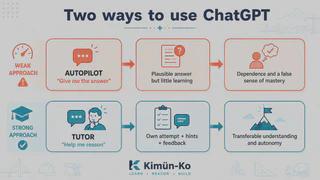
1. The fundamental rule: tutor, not autopilot
A weak query would be:
Explain the water balance.
A much better one would be:
I am taking IIO422-Hydrology in Civil Engineering.

I understand precipitation and streamflow, but I still confuse
evapotranspiration with changes in catchment storage.

Help me interpret the annual water balance physically.
First ask me two diagnostic questions.
Then correct my misconceptions and only afterwards give
a concise explanation.

Use units of mm/year and do not assume Delta S = 0
unless you justify that approximation.
The difference is not cosmetic. The second prompt forces you to think before receiving the explanation.
2. Configure the context that actually matters
The course assumes previous knowledge of Fluid Mechanics, Hydraulics, Statistics and English. It also requires you to collect and analyse hydrometeorological information, construct simplified water balances, perform frequency analysis, and estimate design rainfall and streamflow.
In Settings > Personalization > Custom Instructions, you could write:
I am a Civil Engineering student in Chile taking IIO422-Hydrology.

I have already passed Fluid Mechanics, Hydraulics and Statistics.
I also know how to program in R.

When helping me:
- prioritise reasoning and physical interpretation;
- use SI units;
- check dimensional consistency;
- distinguish data, assumptions, method, result and uncertainty;
- use examples from Chilean catchments when useful;
- do not invent data, references, packages or functions;
- if important information is missing, ask before assuming;
- for R, avoid tidyverse and prioritise base R, hydroTSM
  and the tools specified in the course;
- when I am preparing for an assessment, do not provide
  the full solution before I have attempted the problem.
Do not include personal information that is irrelevant to learning.
3. Connect ChatGPT with the Learning Outcomes
The syllabus defines five Learning Outcomes. Use them as a test of whether an AI interaction is actually helping you learn:
- LO1: conceptually analyse key hydrological-cycle processes and apply them to Chilean catchments.
- LO2: quantify the temporal evolution of precipitation, evapotranspiration and runoff using in-situ and gridded data.
- LO3: analyse hydrological variables probabilistically for engineering design and planning.
- LO4: incorporate social responsibility into water-resources management problems.
- LO5: develop personal and teamwork skills needed to meet agreed objectives and deadlines.
A useful ChatGPT session should strengthen at least one of these outcomes. If it merely produces text or code that you cannot explain, it probably strengthens none of them.
4. The anatomy of a good prompt
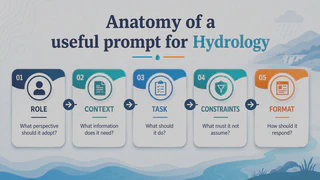
For most course tasks, five components are sufficient:
ROLE + CONTEXT + TASK + CONSTRAINTS + OUTPUT
Role
Act as a university Hydrology lecturer for Civil Engineering.
Context
I am studying infiltration and the Green-Ampt method.
I understand infiltration capacity, but not the role
of initial soil moisture.
Task
Help me compare the same storm over an initially dry soil
and an initially wet soil.
Constraints
Do not invent parameter values.
Use SI units.
Do not simplify the assumptions of Green-Ampt without stating them.
Output
Answer in five parts:
1. physical idea;
2. relevant variables;
3. equation;
4. example;
5. one question to test my understanding.
5. Make the model recognise missing information
A hydrological answer may depend on:
- temporal scale;
- catchment area;
- data resolution;
- hydrological year;
- antecedent conditions;
- rainfall- or snow-dominated regime;
- regulation;
- units;
- availability and quality of observations.
Add:
Before solving the problem, identify whether essential information
is missing.

If it is, ask me no more than three specific questions.
Do not introduce silent assumptions.
6. Use the course learning sequence as a dialogue structure
The syllabus organises learning around:
conceptualisation
→ application
→ evidence analysis
→ perturbation of the problem
→ interpretation
→ defence of results
You can turn that sequence directly into a prompt:
I want to study [TOPIC].

Work with me in six stages:
1. conceptualisation;
2. application;
3. evidence;
4. change one assumption or input;
5. ask me to interpret what changes;
6. make me defend the conclusion.
This is more useful than requesting a long explanation.
7. Separate facts, assumptions, results and uncertainty
For quantitative problems:
Separate your response into:
- available data;
- assumptions;
- equations;
- calculation;
- result;
- physical interpretation;
- uncertainty;
- limitations.
This mirrors the course-wide assessment criteria: conceptual understanding, mathematical correctness, dimensional consistency, hydrological reasoning, physical interpretation, critical judgement and consideration of uncertainty.
8. Fluency does not imply truth
ChatGPT can produce polished but incorrect answers.
Watch especially for:
- unit errors;
- incorrect signs;
- mixed temporal scales;
- confusion between exceedance and non-exceedance;
- methods used outside their assumptions;
- fabricated data;
- non-existent references;
- non-existent R functions;
- causal interpretations unsupported by evidence.
Try:
Audit your answer.

Look specifically for:
1. conceptual errors;
2. dimensional errors;
3. unstated assumptions;
4. physically implausible results;
5. omitted uncertainty;
6. references or functions you cannot verify.
9. AI is not a scientific authority
The syllabus is explicit: AI tools do not replace hydrological analysis and are not sources of scientific authority.
Verify important information using:
- course material;
- textbooks;
- scientific papers;
- official documentation;
- R documentation;
- original data;
- independent calculations;
- physical-consistency checks.
10. Declare AI use in practical assignments
Each practical assignment should include a brief declaration identifying at least:
- tool used;
- purpose;
- component in which it was used;
- verification procedure.
For example:
Tool: ChatGPT.
Purpose: support in debugging an R function for temporal aggregation.
Component: script 02_hydroclimate.R.
Verification: comparison with an independent calculation,
unit checks and consultation of the hydroTSM documentation.
“Used ChatGPT” is not an adequate declaration.
11. Study Mode and Socratic practice
Study Mode is useful for:
- water balance;
- Budyko;
- infiltration;
- hydrograph interpretation;
- FDCs;
- return period;
- IDF curves;
- rainfall-runoff relationships;
- oral-assessment preparation.
For example:
I want to learn return period.

I do not want to memorise T = 1/p.
First diagnose my understanding.
Then give me an engineering-design situation.
Finally ask me about risk over the service life of the structure.
12. Three modes of use
Answer mode: “Calculate ET.”
Tutor mode: “Guide me to derive ET and check the units.”
Examiner mode: “Give me a problem, wait for my solution, then ask follow-up questions.”
For this course, prioritise tutor and examiner modes.
13. Free or Plus?
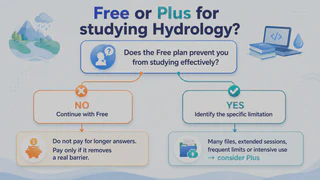
For IIO422, the Free plan is sufficient for most learning tasks.
Plus may become useful if you repeatedly need:
- greater file capacity;
- long debugging sessions;
- higher tool availability;
- longer or more complex analyses;
- intensive use across several courses.
If your household budget is limited: start with Free and only pay for Plus after identifying a specific limitation that is genuinely affecting your work.
14. Five prompts worth saving
Concept
I want to learn [TOPIC].
First diagnose what I understand.
Then correct my gaps using an example from Chile.
Finish with a transfer question.
Problem solving
I will show you a problem and my attempt.
Do not solve it immediately.
Identify the first error, give me one hint, and wait.
Audit
Review the concept, equations, units, calculation,
interpretation, uncertainty and assumptions.
Oral practice
Give me a short oral assessment.
Ask one question at a time.
Use follow-up questions and correct me only at the end.
Error detection
Do not assume my method is correct.
Look for conceptual, numerical, methodological
and interpretative errors.
15. Final rule
Generative AI is permitted for learning activities and preparation of the practical assignments, but not during assessments. The syllabus also makes clear that being unable to explain a procedure included in a submission is evidence that the corresponding learning outcome has not been achieved.
The practical rule is therefore:
If you cannot explain, reproduce, modify and verify something that ChatGPT produced, you should not submit it as part of your work.
Sources
- IIO422-Hydrology course syllabus, Universidad de La Frontera, 2026.
- Baron, M. (2026). AI’s Higher Education Challenge Isn’t Speed. It’s Purpose. The Koala News.
- Tobor, J., & Sommer, T. (2026). CRAFTing the Future: How Universities Can Navigate AI Adoption. Hochschulforum Digitalisierung.
- Vieriu, A. M., & Petrea, G. (2025). The impact of artificial intelligence (AI) on students’ academic development. Education Sciences, 15(3), 343. https://doi.org/10.3390/educsci15030343
- Woon, A. (2025). Transforming Education in the Age of AI: Challenges and Opportunities. Higher Education Policy Institute.
- OpenAI Help: Study Mode
- OpenAI Help: Custom Instructions
- OpenAI Help: Projects
- OpenAI Help: Free Tier FAQ
- OpenAI Help: ChatGPT Plus
Currency note: ChatGPT features, limits and prices change. Always check the official documentation.