
br2
br2.RdCoefficient of determination (r2) multiplied by the slope of the regression line between sim and obs, with treatment of missing values.
Usage
br2(sim, obs, ...)

# Default S3 method
br2(sim, obs, na.rm=TRUE, use.abs=FALSE, fun=NULL, ...,
             epsilon.type=c("none", "Pushpalatha2012", "otherFactor", "otherValue"),
             epsilon.value=NA)

# S3 method for class 'data.frame'
br2(sim, obs, na.rm=TRUE, use.abs=FALSE, fun=NULL, ...,
             epsilon.type=c("none", "Pushpalatha2012", "otherFactor", "otherValue"),
             epsilon.value=NA)

# S3 method for class 'matrix'
br2(sim, obs, na.rm=TRUE, use.abs=FALSE, fun=NULL, ...,
             epsilon.type=c("none", "Pushpalatha2012", "otherFactor", "otherValue"),
             epsilon.value=NA)

# S3 method for class 'zoo'
br2(sim, obs, na.rm=TRUE, use.abs=FALSE, fun=NULL, ...,
             epsilon.type=c("none", "Pushpalatha2012", "otherFactor", "otherValue"),
             epsilon.value=NA)
Arguments
- sim
numeric, zoo, matrix or data.frame with simulated values
- obs
numeric, zoo, matrix or data.frame with observed values
- na.rm
logical value indicating whether 'NA' should be stripped before the computation proceeds.
When an 'NA' value is found at the i-th position inobsORsim, the i-th value ofobsANDsimare removed before the computation.- use.abs
logical value indicating whether the condition to select the formula used to compute
br2should be 'b<=1' or 'abs(b) <=1'.
Krausse et al. (2005) uses 'b<=1' as condition, but strictly speaking this condition should be 'abs(b)<=1'. However, if your model simulations are somewhat "close" to the observations, this condition should not have much impact on the computation of 'br2'.
This argument was introduced in hydroGOF 0.4-0, following a comment by E. White. Its default value isFALSEto ensure compatibility with previous versions of hydroGOF.- fun
function to be applied to
simandobsin order to obtain transformed values thereof before computing this goodness-of-fit index.The first argument MUST BE a numeric vector with any name (e.g.,
x), and additional arguments are passed using....- ...
arguments passed to
fun, in addition to the mandatory first numeric vector.- epsilon.type
argument used to define a numeric value to be added to both
simandobsbefore applyingfun.It is was designed to allow the use of logarithm and other similar functions that do not work with zero values.
Valid values of
epsilon.typeare:1) "none":
simandobsare used byfunwithout the addition of any numeric value. This is the default option.2) "Pushpalatha2012": one hundredth (1/100) of the mean observed values is added to both
simandobsbefore applyingfun, as described in Pushpalatha et al. (2012).3) "otherFactor": the numeric value defined in the
epsilon.valueargument is used to multiply the the mean observed values, instead of the one hundredth (1/100) described in Pushpalatha et al. (2012). The resulting value is then added to bothsimandobs, before applyingfun.4) "otherValue": the numeric value defined in the
epsilon.valueargument is directly added to bothsimandobs, before applyingfun.- epsilon.value
-) when
epsilon.type="otherValue"it represents the numeric value to be added to bothsimandobsbefore applyingfun.
-) whenepsilon.type="otherFactor"it represents the numeric factor used to multiply the mean of the observed values, instead of the one hundredth (1/100) described in Pushpalatha et al. (2012). The resulting value is then added to bothsimandobsbefore applyingfun.
Details
$$ br2 = |b| R2 , b <= 1 ; br2 = \frac{R2}{|b|}, b > 1 $$
A model that systematically over or under-predicts all the time will still result in "good" R2 (close to 1), even if all predictions were wrong (Krause et al., 2005).
The br2 coefficient allows accounting for the discrepancy in the magnitude of two signals (depicted by 'b') as well as their dynamics (depicted by R2)
Value
br2 between sim and obs.
If sim and obs are matrixes, the returned value is a vector, with the br2 between each column of sim and obs.
References
Krause, P.; Boyle, D.P.; Base, F. (2005). Comparison of different efficiency criteria for hydrological model assessment, Advances in Geosciences, 5, 89-97. doi:10.5194/adgeo-5-89-2005.
Krstic, G.; Krstic, N.S.; Zambrano-Bigiarini, M. (2016). The br2-weighting Method for Estimating the Effects of Air Pollution on Population Health. Journal of Modern Applied Statistical Methods, 15(2), 42. doi:10.22237/jmasm/1478004000
Note
obs and sim has to have the same length/dimension
The missing values in obs and sim are removed before the computation proceeds, and only those positions with non-missing values in obs and sim are considered in the computation
The slope b is computed as the coefficient of the linear regression between sim and obs, forcing the intercept be equal to zero.
Examples
##################
# Example 1:
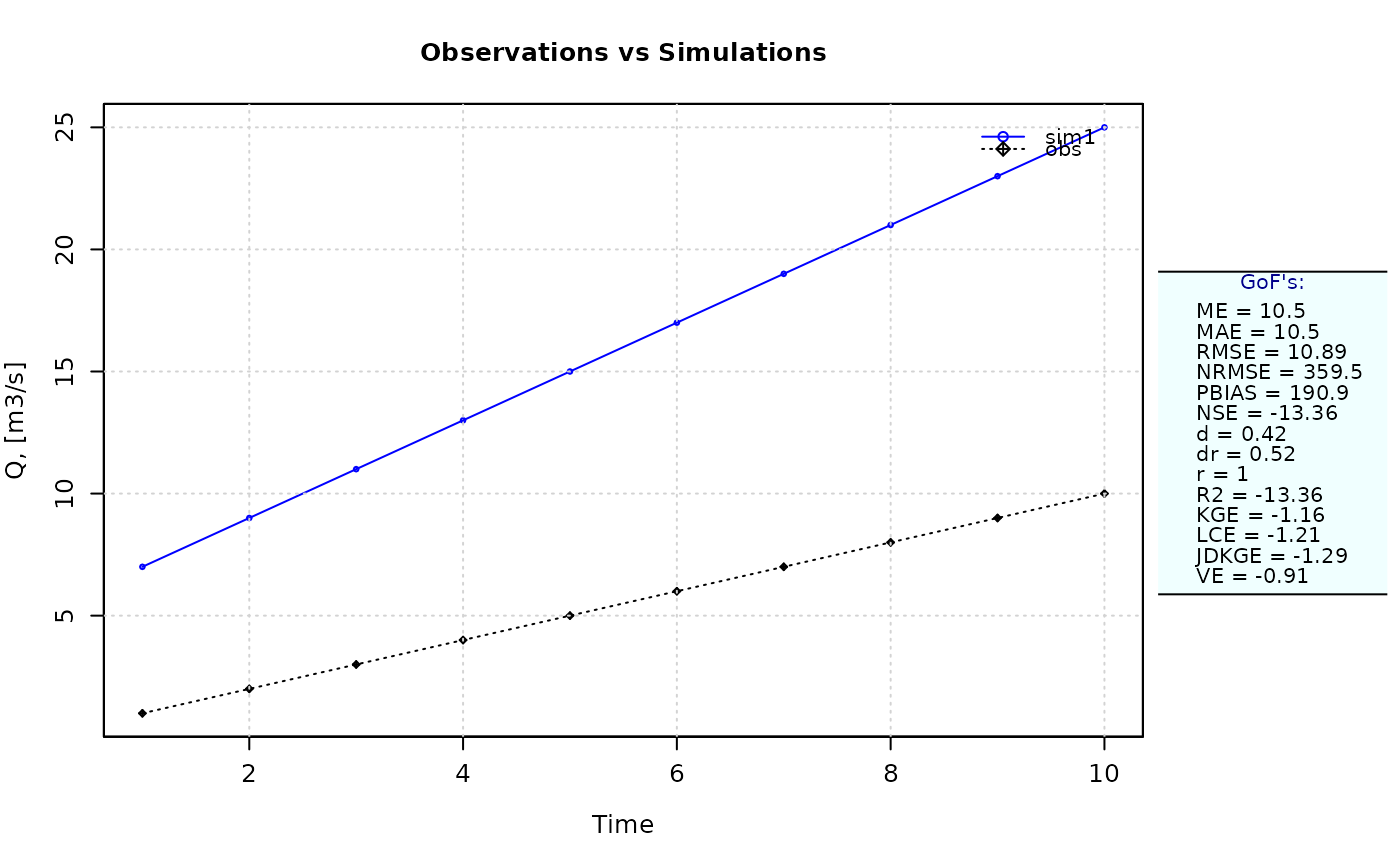
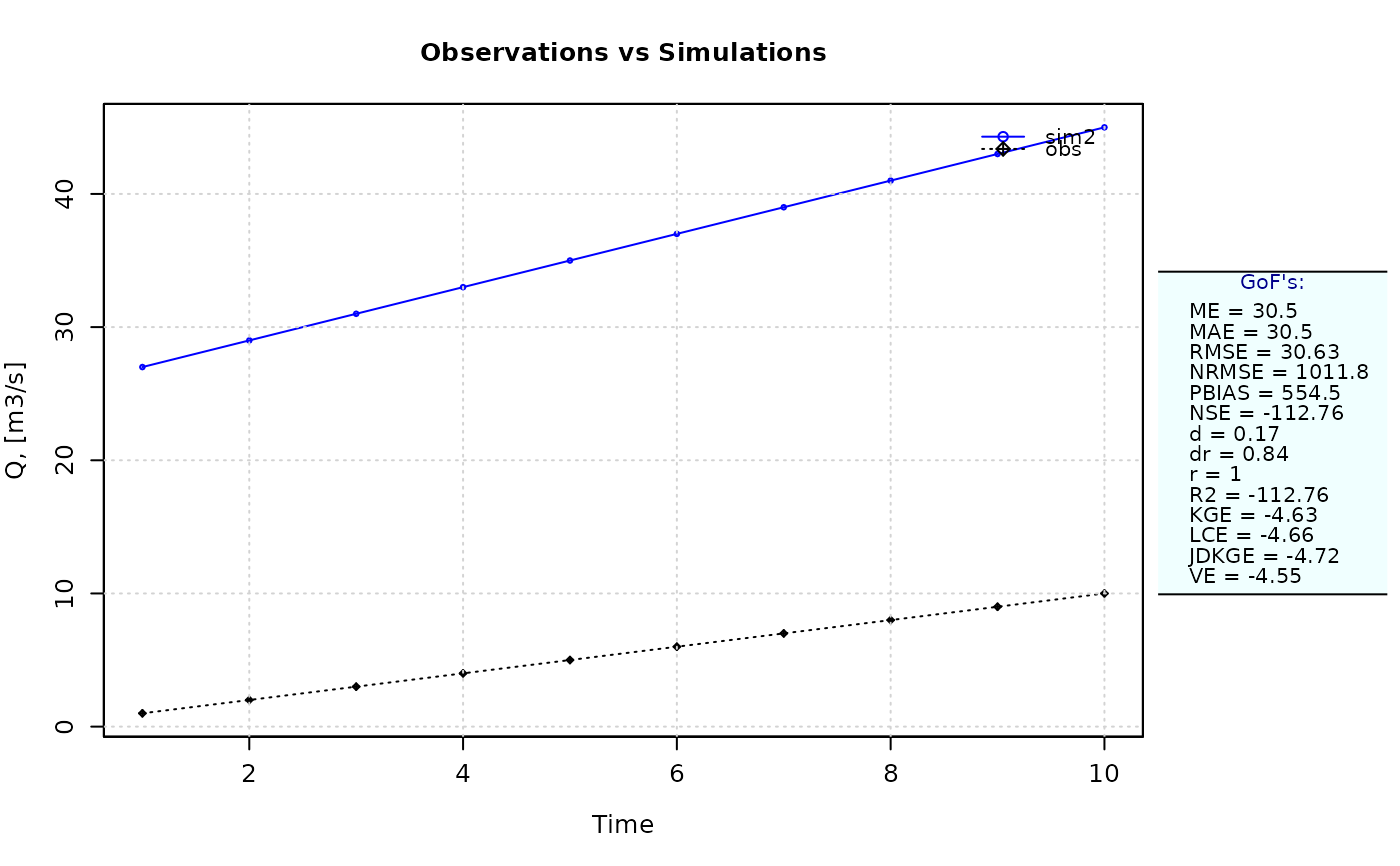
# Looking at the difference between r2 and br2 for a case with systematic
# over-prediction of observed values
obs <- 1:10
sim1 <- 2*obs + 5
sim2 <- 2*obs + 25
# The coefficient of determination is equal to 1 even if there is no one single
# simulated value equal to its corresponding observed counterpart
r2 <- (cor(sim1, obs, method="pearson"))^2 # r2=1
# 'br2' effectively penalises the systematic over-estimation
br2(sim1, obs) # br2 = 0.3684211
#> [1] 0.3684211
br2(sim2, obs) # br2 = 0.1794872
#> [1] 0.1794872
ggof(sim1, obs)
#> [ Note: You did not provide dates, so only a numeric index will be used in the time axis ]
 ggof(sim2, obs)
#> [ Note: You did not provide dates, so only a numeric index will be used in the time axis ]
ggof(sim2, obs)
#> [ Note: You did not provide dates, so only a numeric index will be used in the time axis ]
 # Computing 'br2' without forcing the intercept be equal to zero
br2.2 <- r2/2 # br2 = 0.5
##################
# Example 2:
# Loading daily streamflows of the Ega River (Spain), from 1961 to 1970
data(EgaEnEstellaQts)
obs <- EgaEnEstellaQts
# Generating a simulated daily time series, initially equal to the observed series
sim <- obs
# Computing the 'br2' for the "best" (unattainable) case
br2(sim=sim, obs=obs)
#> [1] 1
##################
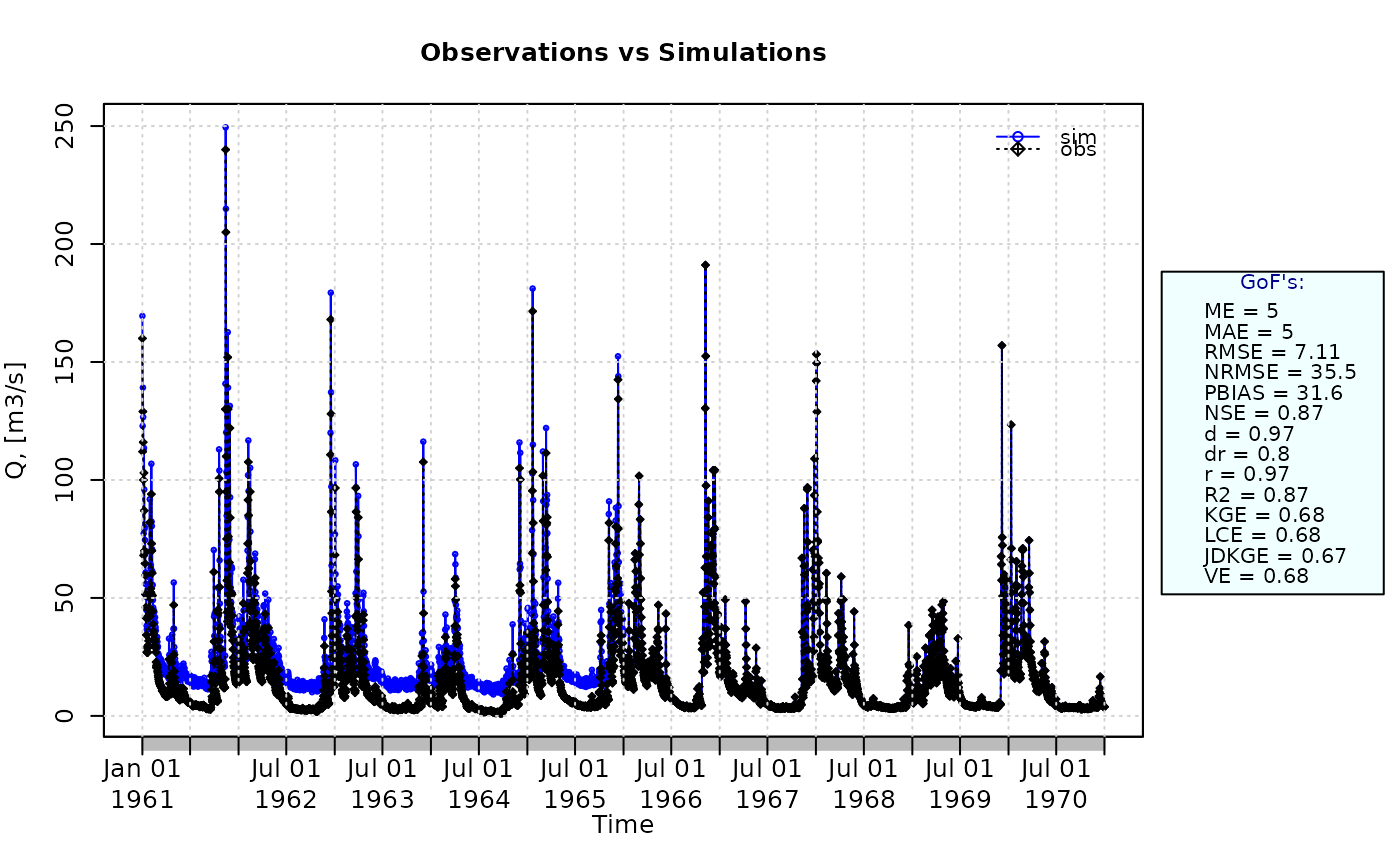
# Example 3: br2 for simulated values equal to observations plus random noise
# on the first half of the observed values.
# This random noise has more relative importance for ow flows than
# for medium and high flows.
# Randomly changing the first 1826 elements of 'sim', by using a normal distribution
# with mean 10 and standard deviation equal to 1 (default of 'rnorm').
sim[1:1826] <- obs[1:1826] + rnorm(1826, mean=10)
ggof(sim, obs)
# Computing 'br2' without forcing the intercept be equal to zero
br2.2 <- r2/2 # br2 = 0.5
##################
# Example 2:
# Loading daily streamflows of the Ega River (Spain), from 1961 to 1970
data(EgaEnEstellaQts)
obs <- EgaEnEstellaQts
# Generating a simulated daily time series, initially equal to the observed series
sim <- obs
# Computing the 'br2' for the "best" (unattainable) case
br2(sim=sim, obs=obs)
#> [1] 1
##################
# Example 3: br2 for simulated values equal to observations plus random noise
# on the first half of the observed values.
# This random noise has more relative importance for ow flows than
# for medium and high flows.
# Randomly changing the first 1826 elements of 'sim', by using a normal distribution
# with mean 10 and standard deviation equal to 1 (default of 'rnorm').
sim[1:1826] <- obs[1:1826] + rnorm(1826, mean=10)
ggof(sim, obs)
 br2(sim=sim, obs=obs)
#> [1] 0.8369002
##################
# Example 4: br2 for simulated values equal to observations plus random noise
# on the first half of the observed values and applying (natural)
# logarithm to 'sim' and 'obs' during computations.
br2(sim=sim, obs=obs, fun=log)
#> [1] 0.605311
# Verifying the previous value:
lsim <- log(sim)
lobs <- log(obs)
br2(sim=lsim, obs=lobs)
#> [1] 0.605311
##################
# Example 5: br2 for simulated values equal to observations plus random noise
# on the first half of the observed values and applying (natural)
# logarithm to 'sim' and 'obs' and adding the Pushpalatha2012 constant
# during computations
br2(sim=sim, obs=obs, fun=log, epsilon.type="Pushpalatha2012")
#> [1] 0.6110949
# Verifying the previous value, with the epsilon value following Pushpalatha2012
eps <- mean(obs, na.rm=TRUE)/100
lsim <- log(sim+eps)
lobs <- log(obs+eps)
br2(sim=lsim, obs=lobs)
#> [1] 0.6110949
##################
# Example 6: br2 for simulated values equal to observations plus random noise
# on the first half of the observed values and applying (natural)
# logarithm to 'sim' and 'obs' and adding a user-defined constant
# during computations
eps <- 0.01
br2(sim=sim, obs=obs, fun=log, epsilon.type="otherValue", epsilon.value=eps)
#> [1] 0.6056873
# Verifying the previous value:
lsim <- log(sim+eps)
lobs <- log(obs+eps)
br2(sim=lsim, obs=lobs)
#> [1] 0.6056873
##################
# Example 7: br2 for simulated values equal to observations plus random noise
# on the first half of the observed values and applying (natural)
# logarithm to 'sim' and 'obs' and using a user-defined factor
# to multiply the mean of the observed values to obtain the constant
# to be added to 'sim' and 'obs' during computations
fact <- 1/50
br2(sim=sim, obs=obs, fun=log, epsilon.type="otherFactor", epsilon.value=fact)
#> [1] 0.61656
# Verifying the previous value:
eps <- fact*mean(obs, na.rm=TRUE)
lsim <- log(sim+eps)
lobs <- log(obs+eps)
br2(sim=lsim, obs=lobs)
#> [1] 0.61656
##################
# Example 8: br2 for simulated values equal to observations plus random noise
# on the first half of the observed values and applying a
# user-defined function to 'sim' and 'obs' during computations
fun1 <- function(x) {sqrt(x+1)}
br2(sim=sim, obs=obs, fun=fun1)
#> [1] 0.7612512
# Verifying the previous value, with the epsilon value following Pushpalatha2012
sim1 <- sqrt(sim+1)
obs1 <- sqrt(obs+1)
br2(sim=sim1, obs=obs1)
#> [1] 0.7612512
br2(sim=sim, obs=obs)
#> [1] 0.8369002
##################
# Example 4: br2 for simulated values equal to observations plus random noise
# on the first half of the observed values and applying (natural)
# logarithm to 'sim' and 'obs' during computations.
br2(sim=sim, obs=obs, fun=log)
#> [1] 0.605311
# Verifying the previous value:
lsim <- log(sim)
lobs <- log(obs)
br2(sim=lsim, obs=lobs)
#> [1] 0.605311
##################
# Example 5: br2 for simulated values equal to observations plus random noise
# on the first half of the observed values and applying (natural)
# logarithm to 'sim' and 'obs' and adding the Pushpalatha2012 constant
# during computations
br2(sim=sim, obs=obs, fun=log, epsilon.type="Pushpalatha2012")
#> [1] 0.6110949
# Verifying the previous value, with the epsilon value following Pushpalatha2012
eps <- mean(obs, na.rm=TRUE)/100
lsim <- log(sim+eps)
lobs <- log(obs+eps)
br2(sim=lsim, obs=lobs)
#> [1] 0.6110949
##################
# Example 6: br2 for simulated values equal to observations plus random noise
# on the first half of the observed values and applying (natural)
# logarithm to 'sim' and 'obs' and adding a user-defined constant
# during computations
eps <- 0.01
br2(sim=sim, obs=obs, fun=log, epsilon.type="otherValue", epsilon.value=eps)
#> [1] 0.6056873
# Verifying the previous value:
lsim <- log(sim+eps)
lobs <- log(obs+eps)
br2(sim=lsim, obs=lobs)
#> [1] 0.6056873
##################
# Example 7: br2 for simulated values equal to observations plus random noise
# on the first half of the observed values and applying (natural)
# logarithm to 'sim' and 'obs' and using a user-defined factor
# to multiply the mean of the observed values to obtain the constant
# to be added to 'sim' and 'obs' during computations
fact <- 1/50
br2(sim=sim, obs=obs, fun=log, epsilon.type="otherFactor", epsilon.value=fact)
#> [1] 0.61656
# Verifying the previous value:
eps <- fact*mean(obs, na.rm=TRUE)
lsim <- log(sim+eps)
lobs <- log(obs+eps)
br2(sim=lsim, obs=lobs)
#> [1] 0.61656
##################
# Example 8: br2 for simulated values equal to observations plus random noise
# on the first half of the observed values and applying a
# user-defined function to 'sim' and 'obs' during computations
fun1 <- function(x) {sqrt(x+1)}
br2(sim=sim, obs=obs, fun=fun1)
#> [1] 0.7612512
# Verifying the previous value, with the epsilon value following Pushpalatha2012
sim1 <- sqrt(sim+1)
obs1 <- sqrt(obs+1)
br2(sim=sim1, obs=obs1)
#> [1] 0.7612512