
Weighted Nash-Sutcliffe efficiency
wNSE.RdWeighted Nash-Sutcliffe efficiency between sim and obs, with treatment of missing values.
This goodness-of-fit measure was proposed by Hundecha and Bardossy (2004) to put special focus on high values.
Usage
wNSE(sim, obs, ...)

# Default S3 method
wNSE(sim, obs, na.rm=TRUE, fun=NULL, ...,
             epsilon.type=c("none", "Pushpalatha2012", "otherFactor", "otherValue"),
             epsilon.value=NA)

# S3 method for class 'data.frame'
wNSE(sim, obs, na.rm=TRUE, fun=NULL, ...,
             epsilon.type=c("none", "Pushpalatha2012", "otherFactor", "otherValue"),
             epsilon.value=NA)

# S3 method for class 'matrix'
wNSE(sim, obs, na.rm=TRUE, fun=NULL, ...,
             epsilon.type=c("none", "Pushpalatha2012", "otherFactor", "otherValue"),
             epsilon.value=NA)

# S3 method for class 'zoo'
wNSE(sim, obs, na.rm=TRUE, fun=NULL, ...,
             epsilon.type=c("none", "Pushpalatha2012", "otherFactor", "otherValue"),
             epsilon.value=NA)
Arguments
- sim
numeric, zoo, matrix or data.frame with simulated values
- obs
numeric, zoo, matrix or data.frame with observed values
- na.rm
a logical value indicating whether 'NA' should be stripped before the computation proceeds.
When an 'NA' value is found at the i-th position inobsORsim, the i-th value ofobsANDsimare removed before the computation.- fun
function to be applied to
simandobsin order to obtain transformed values thereof before computing the weighted Nash-Sutcliffe efficiency.The first argument MUST BE a numeric vector with any name (e.g.,
x), and additional arguments are passed using....- ...
arguments passed to
fun, in addition to the mandatory first numeric vector.- epsilon.type
argument used to define a numeric value to be added to both
simandobsbefore applyingFUN.It is was designed to allow the use of logarithm and other similar functions that do not work with zero values.
Valid values of
epsilon.typeare:1) "none":
simandobsare used byfunwithout the addition of any numeric value. This is the default option.2) "Pushpalatha2012": one hundredth (1/100) of the mean observed values is added to both
simandobsbefore applyingfun, as described in Pushpalatha et al. (2012).3) "otherFactor": the numeric value defined in the
epsilon.valueargument is used to multiply the mean of the observed values, instead of the one hundredth (1/100) described in Pushpalatha et al. (2012). The resulting value is then added to bothsimandobs, before applyingfun.4) "otherValue": the numeric value defined in the
epsilon.valueargument is directly added to bothsimandobs, before applyingfun.- epsilon.value
-) when
epsilon.type="otherValue"it represents the numeric value to be added to bothsimandobsbefore applyingfun.
-) whenepsilon.type="otherFactor"it represents the numeric factor used to multiply the mean of the observed values, instead of the one hundredth (1/100) described in Pushpalatha et al. (2012). The resulting value is then added to bothsimandobsbefore applyingfun.
Details
$$ wNSE = 1 -\frac { \sum_{i=1}^N O_i * ( S_i - O_i )^2 } { \sum_{i=1}^N O_i * ( O_i - \bar{O} )^2 } $$
Value
Weighted Nash-Sutcliffe efficiency between sim and obs.
If sim and obs are matrixes, the returned value is a vector, with the relative Nash-Sutcliffe efficiency between each column of sim and obs.
References
Nash, J.E. and J.V. Sutcliffe, River flow forecasting through conceptual models. Part 1: A discussion of principles, J. Hydrol. 10 (1970), pp. 282-290. doi:10.1016/0022-1694(70)90255-6.
Hundecha, Y., Bardossy, A. (2004). Modeling of the effect of land use changes on the runoff generation of a river basin through parameter regionalization of a watershed model. Journal of hydrology, 292(1-4), 281-295. doi:10.1016/j.jhydrol.2004.01.002.
Hundecha, Y., Ouarda, T. B., Bardossy, A. (2008). Regional estimation of parameters of a rainfall-runoff model at ungauged watersheds using the 'spatial' structures of the parameters within a canonical physiographic-climatic space. Water Resources Research, 44(1). doi:10.1029/2006WR005439.
Hundecha, Y. and Merz, B. (2012), Exploring the Relationship between Changes in Climate and Floods Using a Model-Based Analysis, Water Resour. Res., 48(4), 1-21, doi:10.1029/2011WR010527..
Note
obs and sim has to have the same length/dimension
The missing values in obs and sim are removed before the computation proceeds, and only those positions with non-missing values in obs and sim are considered in the computation
If some of the observed values are equal to zero (at least one of them), this index can not be computed.
Examples
##################
# Example 1: basic ideal case
obs <- 1:10
sim <- 1:10
wNSE(sim, obs)
#> [1] 1
obs <- 1:10
sim <- 2:11
wNSE(sim, obs)
#> [1] 0.8787879
##################
# Example 2:
# Loading daily streamflows of the Ega River (Spain), from 1961 to 1970
data(EgaEnEstellaQts)
obs <- EgaEnEstellaQts
# Generating a simulated daily time series, initially equal to the observed series
sim <- obs
# Computing the 'wNSE' for the "best" (unattainable) case
wNSE(sim=sim, obs=obs)
#> [1] 1
##################
# Example 3: wNSE for simulated values equal to observations plus random noise
# on the first half of the observed values.
# This random noise has more relative importance for ow flows than
# for medium and high flows.
# Randomly changing the first 1826 elements of 'sim', by using a normal distribution
# with mean 10 and standard deviation equal to 1 (default of 'rnorm').
sim[1:1826] <- obs[1:1826] + rnorm(1826, mean=10)
ggof(sim, obs)
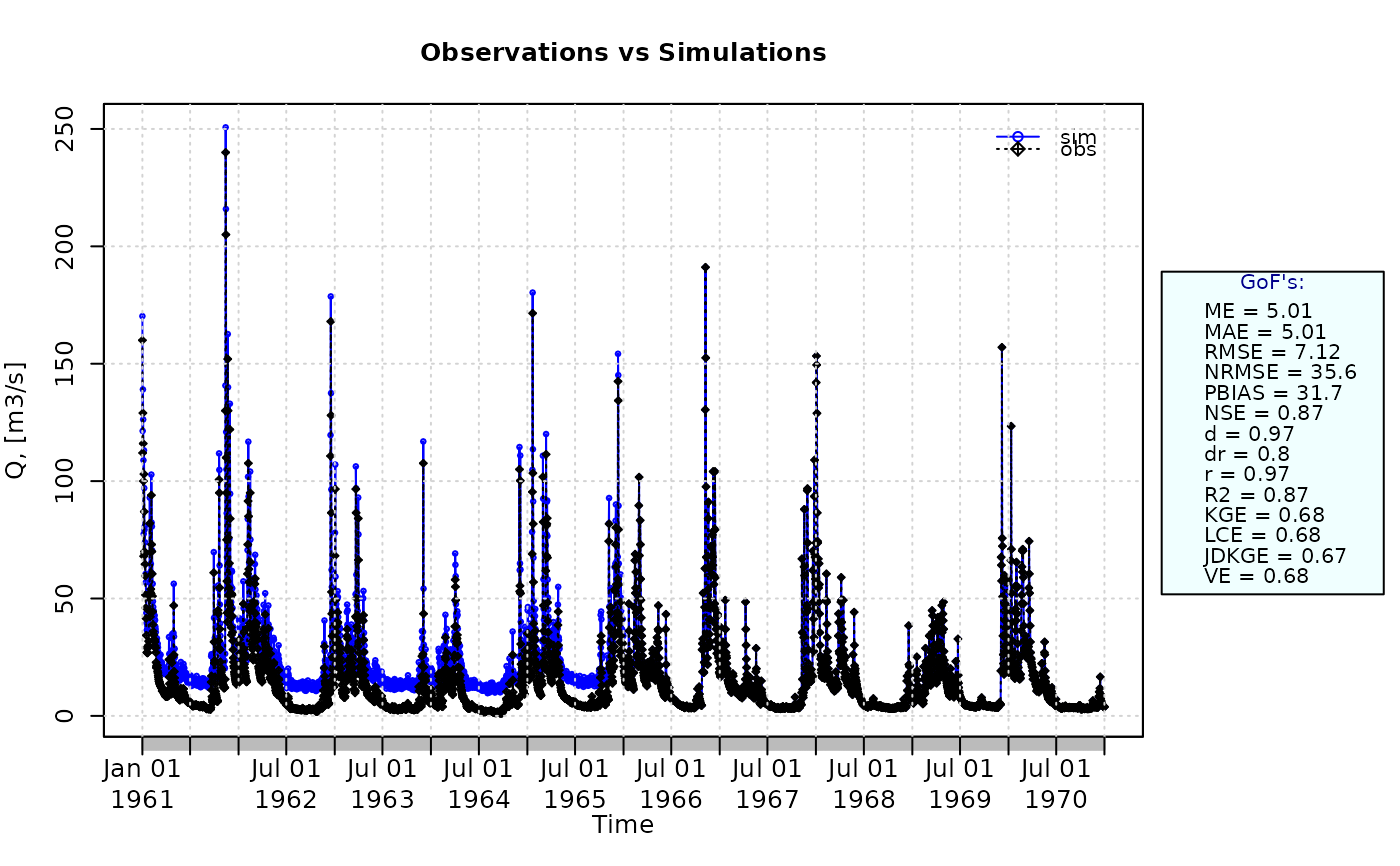 wNSE(sim=sim, obs=obs)
#> [1] 0.9768409
##################
# Example 4: wNSE for simulated values equal to observations plus random noise
# on the first half of the observed values and applying (natural)
# logarithm to 'sim' and 'obs' during computations.
wNSE(sim=sim, obs=obs, fun=log)
#> [1] 0.7418048
# Verifying the previous value:
lsim <- log(sim)
lobs <- log(obs)
wNSE(sim=lsim, obs=lobs)
#> [1] 0.7418048
##################
# Example 5: wNSE for simulated values equal to observations plus random noise
# on the first half of the observed values and applying (natural)
# logarithm to 'sim' and 'obs' and adding the Pushpalatha2012 constant
# during computations
wNSE(sim=sim, obs=obs, fun=log, epsilon.type="Pushpalatha2012")
#> [1] 0.7379411
# Verifying the previous value, with the epsilon value following Pushpalatha2012
eps <- mean(obs, na.rm=TRUE)/100
lsim <- log(sim+eps)
lobs <- log(obs+eps)
wNSE(sim=lsim, obs=lobs)
#> [1] 0.7379411
##################
# Example 6: wNSE for simulated values equal to observations plus random noise
# on the first half of the observed values and applying (natural)
# logarithm to 'sim' and 'obs' and adding a user-defined constant
# during computations
eps <- 0.01
wNSE(sim=sim, obs=obs, fun=log, epsilon.type="otherValue", epsilon.value=eps)
#> [1] 0.7415356
# Verifying the previous value:
lsim <- log(sim+eps)
lobs <- log(obs+eps)
wNSE(sim=lsim, obs=lobs)
#> [1] 0.7415356
##################
# Example 7: wNSE for simulated values equal to observations plus random noise
# on the first half of the observed values and applying (natural)
# logarithm to 'sim' and 'obs' and using a user-defined factor
# to multiply the mean of the observed values to obtain the constant
# to be added to 'sim' and 'obs' during computations
fact <- 1/50
wNSE(sim=sim, obs=obs, fun=log, epsilon.type="otherFactor", epsilon.value=fact)
#> [1] 0.734794
# Verifying the previous value:
eps <- fact*mean(obs, na.rm=TRUE)
lsim <- log(sim+eps)
lobs <- log(obs+eps)
wNSE(sim=lsim, obs=lobs)
#> [1] 0.734794
##################
# Example 8: wNSE for simulated values equal to observations plus random noise
# on the first half of the observed values and applying a
# user-defined function to 'sim' and 'obs' during computations
fun1 <- function(x) {sqrt(x+1)}
wNSE(sim=sim, obs=obs, fun=fun1)
#> [1] 0.886944
# Verifying the previous value
sim1 <- sqrt(sim+1)
obs1 <- sqrt(obs+1)
wNSE(sim=sim1, obs=obs1)
#> [1] 0.886944
wNSE(sim=sim, obs=obs)
#> [1] 0.9768409
##################
# Example 4: wNSE for simulated values equal to observations plus random noise
# on the first half of the observed values and applying (natural)
# logarithm to 'sim' and 'obs' during computations.
wNSE(sim=sim, obs=obs, fun=log)
#> [1] 0.7418048
# Verifying the previous value:
lsim <- log(sim)
lobs <- log(obs)
wNSE(sim=lsim, obs=lobs)
#> [1] 0.7418048
##################
# Example 5: wNSE for simulated values equal to observations plus random noise
# on the first half of the observed values and applying (natural)
# logarithm to 'sim' and 'obs' and adding the Pushpalatha2012 constant
# during computations
wNSE(sim=sim, obs=obs, fun=log, epsilon.type="Pushpalatha2012")
#> [1] 0.7379411
# Verifying the previous value, with the epsilon value following Pushpalatha2012
eps <- mean(obs, na.rm=TRUE)/100
lsim <- log(sim+eps)
lobs <- log(obs+eps)
wNSE(sim=lsim, obs=lobs)
#> [1] 0.7379411
##################
# Example 6: wNSE for simulated values equal to observations plus random noise
# on the first half of the observed values and applying (natural)
# logarithm to 'sim' and 'obs' and adding a user-defined constant
# during computations
eps <- 0.01
wNSE(sim=sim, obs=obs, fun=log, epsilon.type="otherValue", epsilon.value=eps)
#> [1] 0.7415356
# Verifying the previous value:
lsim <- log(sim+eps)
lobs <- log(obs+eps)
wNSE(sim=lsim, obs=lobs)
#> [1] 0.7415356
##################
# Example 7: wNSE for simulated values equal to observations plus random noise
# on the first half of the observed values and applying (natural)
# logarithm to 'sim' and 'obs' and using a user-defined factor
# to multiply the mean of the observed values to obtain the constant
# to be added to 'sim' and 'obs' during computations
fact <- 1/50
wNSE(sim=sim, obs=obs, fun=log, epsilon.type="otherFactor", epsilon.value=fact)
#> [1] 0.734794
# Verifying the previous value:
eps <- fact*mean(obs, na.rm=TRUE)
lsim <- log(sim+eps)
lobs <- log(obs+eps)
wNSE(sim=lsim, obs=lobs)
#> [1] 0.734794
##################
# Example 8: wNSE for simulated values equal to observations plus random noise
# on the first half of the observed values and applying a
# user-defined function to 'sim' and 'obs' during computations
fun1 <- function(x) {sqrt(x+1)}
wNSE(sim=sim, obs=obs, fun=fun1)
#> [1] 0.886944
# Verifying the previous value
sim1 <- sqrt(sim+1)
obs1 <- sqrt(obs+1)
wNSE(sim=sim1, obs=obs1)
#> [1] 0.886944