Why R-based models matter
Many hydrological and environmental models used in research are
already available as R functions. For those models,
hydroPSO can run the calibration directly in R, without
preparing temporary input files, launching an external executable, or
parsing model-output files after every particle evaluation.
This is the role of fn = "hydromodInR": it keeps the PSO
engine general, while letting the modeller provide the R function that
turns a candidate parameter set into simulated values and a
goodness-of-fit value. The same idea supports lumped conceptual models,
snow-rainfall-runoff models, regional experiments, sensitivity analyses,
and reproducible teaching examples.
The basic workflow
The calibration of an R-based model with
hydroPSO has a compact workflow, which is illustrated by
the figure shown below:
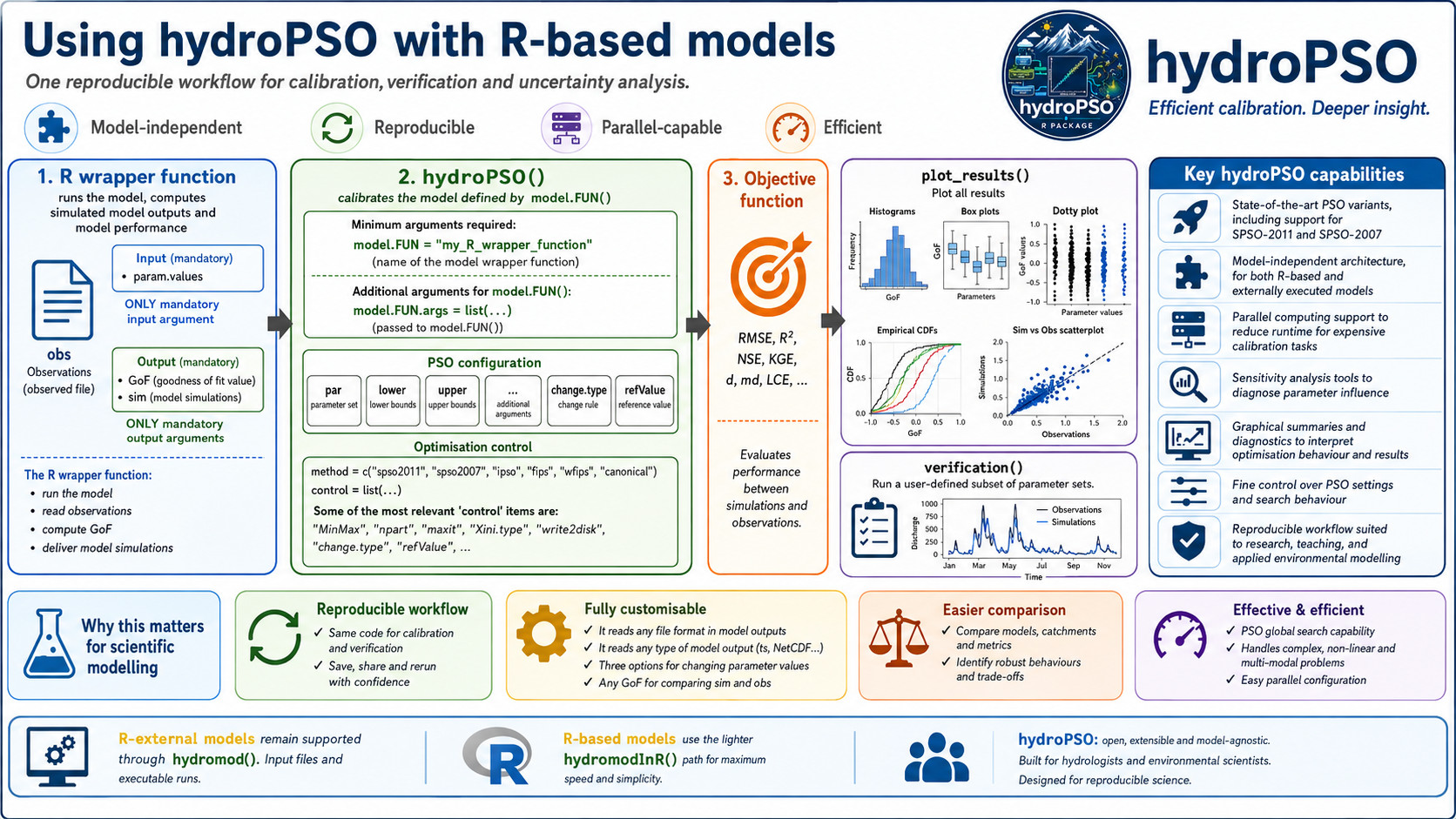
- R wrapper function: this is a user-defined function that:
- takes a parameter set (
param.values) as first mandatory argument - runs the R-based model using that parameter set,
- reads model outputs and observations,
- computes the model’s performance.
-
hydroPSO engine: this is the main function of the
hydroPSOpackage, which updates the parameter sets throughout the iterations. This function:
- takes as first argument
fn="hydromodInR", which tellshydroPSOthat we are going to optimise an R-based model (and not an external model), - takes the R wrapper function defined in the previous step
(
model.FUNandmodel.FUN.args), - takes a parameter set (
par), coming either from the initialisation method defined by theXini.typeargument during the first iteration or from the PSO engine during all subsequent iterations, - takes the
lowerandupperbounds of the parameter space, - takes the user-defined method for changing the model parameters, by
default
change.type="repl", - takes the user-defined PSO engine (by default,
method="SPSO-2011"), - provides several optional ways to customise the
hydroPSObehaviour and the delivery of model outputs, - uses the
hydromodInR()function to pass the parameter set to the user-defined R wrapper function, run the model, compute model simulations, and evaluate model performance.
Computation of model performance (aka GoF, short for goodness-of-fit metric). The computation of model performance is carried out within the R wrapper function, using either a user-defined metric or any of the several GoFs available in the
hydroGOFR package.Several automatically generated diagnostic figures. When the model calibration is finished, the model is run one final time using the best parameter set found during the optimisation. The
plot_resultsfunction can then be used to automatically produce more than 10 diagnostic figures (e.g., convergence plots, dotty plots, histograms, ECDFs, and simulated vs observed plots). The full set of figures can be inspected with?plot_results.The same R wrapper function can later be reused within the
verification()function to run a subset of the parameter sets used during the optimisation and evaluate their performance over a different temporal period.
In practice, the modeller controls the scientific aspects of the
workflow: parameter meaning, model states, warm-up period, observations,
transformations, objective function, and diagnostic outputs.
hydroPSO controls the optimisation bookkeeping.
out <- hydroPSO(
  fn = "hydromodInR",
  lower = lower,
  upper = upper,
  model.FUN = "run_my_model",
  model.FUN.args = list(
    inputs = InputsModel,
    run.options = RunOptions,
    obs = Qobs
  )
)
The model function can be as thin or as rich as needed. For example,
it can call TUWmodel, airGR::RunModel_GR4J(),
airGR::RunModel_CemaNeigeGR6J(), or a project-specific
model function, then return the value that hydroPSO must
minimise or maximise.
Why this is useful for scientific work
<strong>Transparent parameter mapping</strong>
Parameters enter the model as an R object, so names, units, transformations and bounds can be checked directly in the calibration script.
<strong>Less file-system overhead</strong>
R-based runs avoid repeated writing, copying and reading of model input and output files during every particle evaluation.<strong>Cleaner verification</strong>
The same wrapper used for calibration can be reused with independent periods, behavioural parameter sets, and alternative objective functions.<strong>Comparable experiments</strong>
Several model structures can be calibrated with the same PSO settings, objective functions and plotting tools.For hydrologists and environmental scientists, this makes
hydroPSO useful as a bridge between model development and
model evaluation. A prototype can be calibrated while it is still an R
function, and later compared with established model structures using a
common optimisation framework.
Examples covered by the hydroPSO tutorials
The R-based tutorials use the Trancura River Basin in Chile to show the same workflow across different hydrological model structures:
- GR4J: a parsimonious rainfall-runoff model commonly used for catchment-scale hydrology.
- CemaNeige-GR6J: a snow-aware model configuration for basins where snow accumulation and melt affect streamflow.
- TUWmodel: a semi-distributed conceptual model with a larger parameter set and a different internal structure.
These examples are intentionally complementary. They show that the R-based interface is not tied to a single package or model family; it is tied to a reproducible modelling contract.
Relationship with R-external models
R-external models remain fully supported by hydroPSO.
They are still the right choice when the scientific model is a compiled
program or a command-line tool that communicates through input and
output files. In that workflow, hydromod() modifies files,
launches the model run, reads the model output and evaluates the
objective function.
R-based models use the lighter hydromodInR() path. The
optimisation logic is the same, but the model evaluation happens
directly through R function calls. This makes the R-based workflow
especially attractive for exploratory research, teaching, multi-model
comparison, and fast iteration on new model structures.
Since hydroPSO v0.6-0, R-based models can also use
change.type = c("repl", "addi", "mult"), with one change
type for all parameters or one change type per parameter. This gives
R-based and R-external models the same language for replacement,
additive and multiplicative parameter updates.
A practical rule
Use fn = "hydromodInR" when the model can be evaluated
as an R function and the main scientific task is to explore parameter
values, objective functions, calibration periods or model structures.
Use the R-external workflow when the model must be driven through files
and an external executable. Both paths use the same PSO engine; the
difference is how a candidate parameter set is translated into one model
evaluation.