
Unbiased Root Mean Square Error
ubRMSE.Rdunbiased Root Mean Square Error (ubRMSE) between sim and obs, in the same units of sim and obs, with treatment of missing values.
ubRMSE was introduced by Entekhabi et al. (2010) to improve the evaluation of the temporal dynamic of volumentric soil moisture, by removing from the traditional RMSE the mean bias error caused by the mistmatch between the spatial representativeness of in situ soil moisture and the corresponding gridded values.
A smaller value indicates better model performance.
Usage
ubRMSE(sim, obs, ...)

# Default S3 method
ubRMSE(sim, obs, na.rm=TRUE, fun=NULL, ...,
              epsilon.type=c("none", "Pushpalatha2012", "otherFactor", "otherValue"),
              epsilon.value=NA)

# S3 method for class 'data.frame'
ubRMSE(sim, obs, na.rm=TRUE, fun=NULL, ...,
              epsilon.type=c("none", "Pushpalatha2012", "otherFactor", "otherValue"),
              epsilon.value=NA)

# S3 method for class 'matrix'
ubRMSE(sim, obs, na.rm=TRUE, fun=NULL, ...,
              epsilon.type=c("none", "Pushpalatha2012", "otherFactor", "otherValue"),
              epsilon.value=NA)

# S3 method for class 'zoo'
ubRMSE(sim, obs, na.rm=TRUE, fun=NULL, ...,
              epsilon.type=c("none", "Pushpalatha2012", "otherFactor", "otherValue"),
              epsilon.value=NA)
Arguments
- sim
numeric, zoo, matrix or data.frame with simulated values
- obs
numeric, zoo, matrix or data.frame with observed values
- na.rm
a logical value indicating whether 'NA' should be stripped before the computation proceeds.
When an 'NA' value is found at the i-th position inobsORsim, the i-th value ofobsANDsimare removed before the computation.- fun
function to be applied to
simandobsin order to obtain transformed values thereof before computing the Root Mean Square Error.The first argument MUST BE a numeric vector with any name (e.g.,
x), and additional arguments are passed using....- ...
arguments passed to
fun, in addition to the mandatory first numeric vector.- epsilon.type
argument used to define a numeric value to be added to both
simandobsbefore applyingFUN.It is was designed to allow the use of logarithm and other similar functions that do not work with zero values.
Valid values of
epsilon.typeare:1) "none":
simandobsare used byfunwithout the addition of any numeric value. This is the default option.2) "Pushpalatha2012": one hundredth (1/100) of the mean observed values is added to both
simandobsbefore applyingfun, as described in Pushpalatha et al. (2012).3) "otherFactor": the numeric value defined in the
epsilon.valueargument is used to multiply the the mean observed values, instead of the one hundredth (1/100) described in Pushpalatha et al. (2012). The resulting value is then added to bothsimandobs, before applyingfun.4) "otherValue": the numeric value defined in the
epsilon.valueargument is directly added to bothsimandobs, before applyingfun.- epsilon.value
numeric value to be added to both
simandobswhenepsilon.type="otherValue".
Details
The traditional root mean square error (RMSE) is severely compromised if there are biases in either the mean or the amplitude of fluctuations of the simulated values. If it can be estimated reliably, the mean-bias (BIAS) can easily be removed from RMSE, leading to the unbiased RMSE:
$$ ubRMSE = \sqrt{ RMSE^2 - BIAS^2 } $$
Value
Unbiased Root mean square error (ubRMSE) between sim and obs.
If sim and obs are matrixes or data.frames, the returned value is a vector, with the ubRMSE between each column of sim and obs.
References
Entekhabi, D.; Reichle, R.H.; Koster, R.D.; Crow, W.T. (2010). Performance metrics for soil moisture retrievals and application requirements. Journal of Hydrometeorology, 11(3), 832-840. doi: 10.1175/2010JHM1223.1.
Ling, X.; Huang, Y.; Guo, W.; Wang, Y.; Chen, C.; Qiu, B.; Ge, J.; Qin, K.; Xue, Y.; Peng, J. (2021). Comprehensive evaluation of satellite-based and reanalysis soil moisture products using in situ observations over China. Hydrology and Earth System Sciences, 25(7), 4209-4229. doi:10.5194/hess-25-4209-2021.
Note
obs and sim has to have the same length/dimension
The missing values in obs and sim are removed before the computation proceeds, and only those positions with non-missing values in obs and sim are considered in the computation
Examples
##################
# Example 1: basic ideal case
obs <- 1:10
sim <- 1:10
ubRMSE(sim, obs)
#> [1] 0
obs <- 1:10
sim <- 2:11
ubRMSE(sim, obs)
#> [1] 0
##################
# Example 2:
# Loading daily streamflows of the Ega River (Spain), from 1961 to 1970
data(EgaEnEstellaQts)
obs <- EgaEnEstellaQts
# Generating a simulated daily time series, initially equal to the observed series
sim <- obs
# Computing the 'ubRMSE' for the "best" (unattainable) case
ubRMSE(sim=sim, obs=obs)
#> [1] 0
##################
# Example 3: ubRMSE for simulated values equal to observations plus random noise
# on the first half of the observed values.
# This random noise has more relative importance for ow flows than
# for medium and high flows.
# Randomly changing the first 1826 elements of 'sim', by using a normal distribution
# with mean 10 and standard deviation equal to 1 (default of 'rnorm').
sim[1:1826] <- obs[1:1826] + rnorm(1826, mean=10)
ggof(sim, obs)
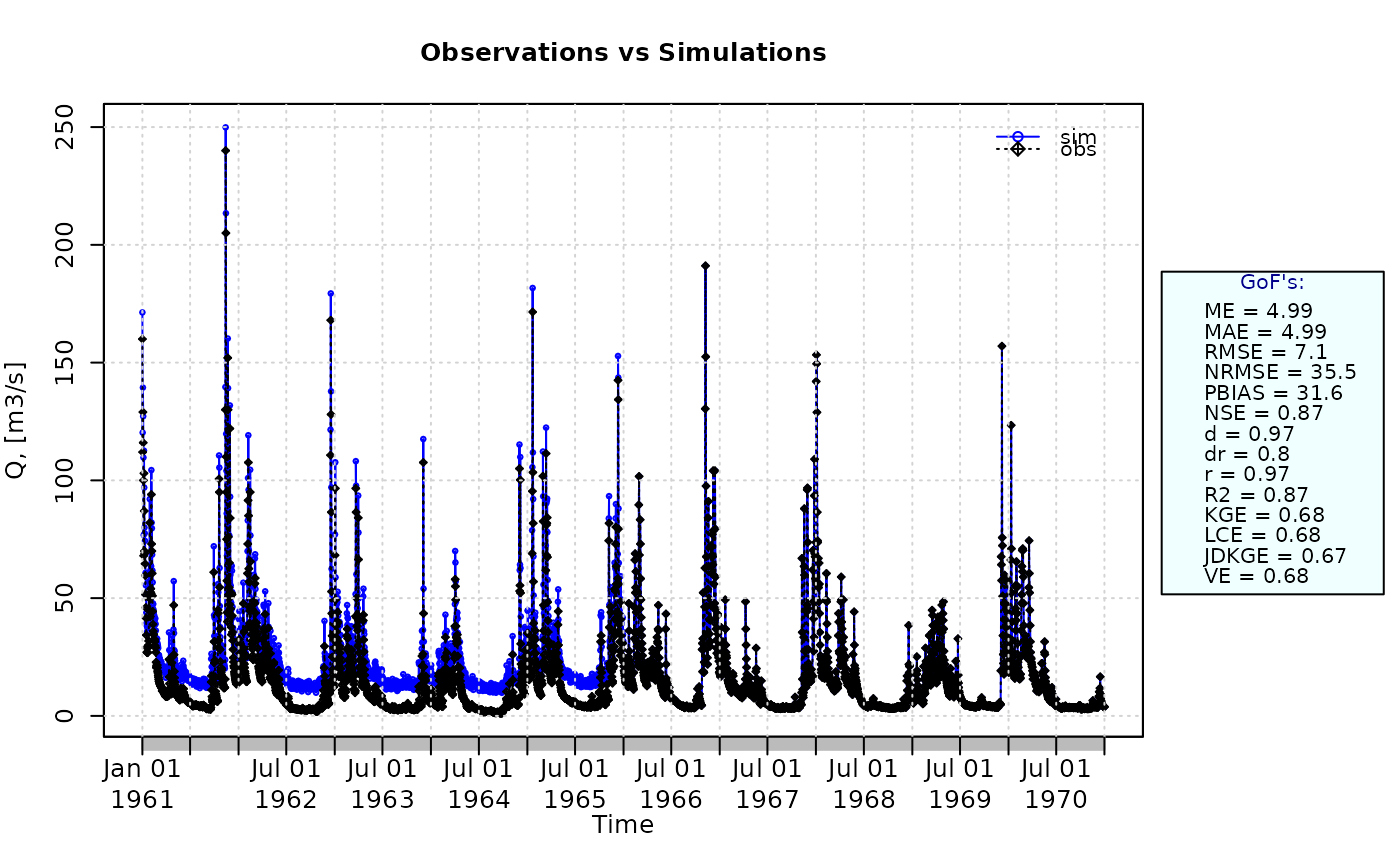 ubRMSE(sim=sim, obs=obs)
#> [1] 5.04438
##################
# Example 4: ubRMSE for simulated values equal to observations plus random noise
# on the first half of the observed values and applying (natural)
# logarithm to 'sim' and 'obs' during computations.
ubRMSE(sim=sim, obs=obs, fun=log)
#> [1] 0.5525138
# Verifying the previous value:
lsim <- log(sim)
lobs <- log(obs)
ubRMSE(sim=lsim, obs=lobs)
#> [1] 0.5525138
##################
# Example 5: ubRMSE for simulated values equal to observations plus random noise
# on the first half of the observed values and applying (natural)
# logarithm to 'sim' and 'obs' and adding the Pushpalatha2012 constant
# during computations
ubRMSE(sim=sim, obs=obs, fun=log, epsilon.type="Pushpalatha2012")
#> [1] 0.5375517
# Verifying the previous value, with the epsilon value following Pushpalatha2012
eps <- mean(obs, na.rm=TRUE)/100
lsim <- log(sim+eps)
lobs <- log(obs+eps)
ubRMSE(sim=lsim, obs=lobs)
#> [1] 0.5375517
##################
# Example 6: ubRMSE for simulated values equal to observations plus random noise
# on the first half of the observed values and applying (natural)
# logarithm to 'sim' and 'obs' and adding a user-defined constant
# during computations
eps <- 0.01
ubRMSE(sim=sim, obs=obs, fun=log, epsilon.type="otherValue", epsilon.value=eps)
#> [1] 0.5515315
# Verifying the previous value:
lsim <- log(sim+eps)
lobs <- log(obs+eps)
ubRMSE(sim=lsim, obs=lobs)
#> [1] 0.5515315
##################
# Example 7: ubRMSE for simulated values equal to observations plus random noise
# on the first half of the observed values and applying (natural)
# logarithm to 'sim' and 'obs' and using a user-defined factor
# to multiply the mean of the observed values to obtain the constant
# to be added to 'sim' and 'obs' during computations
fact <- 1/50
ubRMSE(sim=sim, obs=obs, fun=log, epsilon.type="otherFactor", epsilon.value=fact)
#> [1] 0.5236909
# Verifying the previous value:
eps <- fact*mean(obs, na.rm=TRUE)
lsim <- log(sim+eps)
lobs <- log(obs+eps)
ubRMSE(sim=lsim, obs=lobs)
#> [1] 0.5236909
##################
# Example 8: ubRMSE for simulated values equal to observations plus random noise
# on the first half of the observed values and applying a
# user-defined function to 'sim' and 'obs' during computations
fun1 <- function(x) {sqrt(x+1)}
ubRMSE(sim=sim, obs=obs, fun=fun1)
#> [1] 0.7082036
# Verifying the previous value, with the epsilon value following Pushpalatha2012
sim1 <- sqrt(sim+1)
obs1 <- sqrt(obs+1)
ubRMSE(sim=sim1, obs=obs1)
#> [1] 0.7082036
ubRMSE(sim=sim, obs=obs)
#> [1] 5.04438
##################
# Example 4: ubRMSE for simulated values equal to observations plus random noise
# on the first half of the observed values and applying (natural)
# logarithm to 'sim' and 'obs' during computations.
ubRMSE(sim=sim, obs=obs, fun=log)
#> [1] 0.5525138
# Verifying the previous value:
lsim <- log(sim)
lobs <- log(obs)
ubRMSE(sim=lsim, obs=lobs)
#> [1] 0.5525138
##################
# Example 5: ubRMSE for simulated values equal to observations plus random noise
# on the first half of the observed values and applying (natural)
# logarithm to 'sim' and 'obs' and adding the Pushpalatha2012 constant
# during computations
ubRMSE(sim=sim, obs=obs, fun=log, epsilon.type="Pushpalatha2012")
#> [1] 0.5375517
# Verifying the previous value, with the epsilon value following Pushpalatha2012
eps <- mean(obs, na.rm=TRUE)/100
lsim <- log(sim+eps)
lobs <- log(obs+eps)
ubRMSE(sim=lsim, obs=lobs)
#> [1] 0.5375517
##################
# Example 6: ubRMSE for simulated values equal to observations plus random noise
# on the first half of the observed values and applying (natural)
# logarithm to 'sim' and 'obs' and adding a user-defined constant
# during computations
eps <- 0.01
ubRMSE(sim=sim, obs=obs, fun=log, epsilon.type="otherValue", epsilon.value=eps)
#> [1] 0.5515315
# Verifying the previous value:
lsim <- log(sim+eps)
lobs <- log(obs+eps)
ubRMSE(sim=lsim, obs=lobs)
#> [1] 0.5515315
##################
# Example 7: ubRMSE for simulated values equal to observations plus random noise
# on the first half of the observed values and applying (natural)
# logarithm to 'sim' and 'obs' and using a user-defined factor
# to multiply the mean of the observed values to obtain the constant
# to be added to 'sim' and 'obs' during computations
fact <- 1/50
ubRMSE(sim=sim, obs=obs, fun=log, epsilon.type="otherFactor", epsilon.value=fact)
#> [1] 0.5236909
# Verifying the previous value:
eps <- fact*mean(obs, na.rm=TRUE)
lsim <- log(sim+eps)
lobs <- log(obs+eps)
ubRMSE(sim=lsim, obs=lobs)
#> [1] 0.5236909
##################
# Example 8: ubRMSE for simulated values equal to observations plus random noise
# on the first half of the observed values and applying a
# user-defined function to 'sim' and 'obs' during computations
fun1 <- function(x) {sqrt(x+1)}
ubRMSE(sim=sim, obs=obs, fun=fun1)
#> [1] 0.7082036
# Verifying the previous value, with the epsilon value following Pushpalatha2012
sim1 <- sqrt(sim+1)
obs1 <- sqrt(obs+1)
ubRMSE(sim=sim1, obs=obs1)
#> [1] 0.7082036