Dr. Mauricio Zambrano-Bigiarini 🏥

Dr. Mauricio Zambrano-Bigiarini

(he/him)

Associate Professor

Department of Civil Engineering, Universidad de La Frontera, Temuco, Chile

Professional Summary

I am an Associate Professor in the Department of Civil Engineering at the University of La Frontera, where I lead the Water Resources Observatory Kimün-Ko. I hold a PhD in Environmental Engineering from the University of Trento (Italy) and completed postdoctoral training at the European Commission’s Joint Research Centre.

I have more than 20 years of experience in water resources research and have previously served as an Associate Researcher at the Center for Climate and Resilience Research (CR)2 and as a member of the Earth Sciences Assessment Group of the Chilean National Research and Development Agency (ANID).

My research lies at the interface of hydrology, data science, and environmental sciences, with a particular focus on the use of gridded datasets and open-source tools to investigate droughts, extreme events, and water-related impacts of global change.

I work across spatial and temporal scales to improve the understanding of catchment-scale hydrological processes and to translate this knowledge into operational modelling, forecasting, and early-warning systems that support robust environmental decision-making.

Please reach out to collaborate 😃

Education

PhD in Environmental Engineering

2007-01-01
2010-07-31

Università degli Studi di Trento, Trento, Italy

Diploma in Water Pollution

2002-08-01
2002-10-31

Universidad de Chile, Santiago, Chile

Diploma in Environmental Management

2002-11-01
2002-12-31

Universidad de Chile, Santiago, Chile

Civil Engineer

1992-03-01
1998-12-31

Universidad de Concepción, Concepción, Chile

Interests

Use of gridded data (e.g., P, ET, SM) for drought monitoring and hydrological modelling at various spatial and temporal scales. Analysis of extreme precipitation events and the catchment’s response to such events. Global optimization and sensitivity analysis of hydrological models. Development of R packages for management and analysis of hydrometeorological dataarning.
📚 My Research

My current research focuses on advancing the understanding and practical application of hydrological and hydrometeorological processes through the integration of data, models, and open-source tools. My main research interests include:

  • hydrometeorological modelling and forecasting based on large-scale and gridded datasets;
  • development of open-source, data-driven tools for the operational monitoring of droughts, floods, and other extreme events;
  • global optimisation, uncertainty quantification, and sensitivity analysis of hydrological models; and
  • assessment of catchment-scale responses to extreme precipitation under climate variability and change.

These research activities have supported the establishment of a novel network of in situ precipitation and soil-moisture monitoring sites across five experimental catchments in Chile. The catchments span a wide range of hydrometeorological and geomorphological conditions, from the Mediterranean climate of Valparaíso to the humid environments of the Araucanía region. Within these experimental basins, I test hypotheses on hydrological behaviour using multiple data sources and complementary modelling approaches.

Across all projects, my overarching goal is to deliver reliable estimates of the impacts of global change and extreme events at the catchment scale, generating actionable knowledge to support robust water management and environmental decision-making.

Please reach out to collaborate 😃
Featured Publications

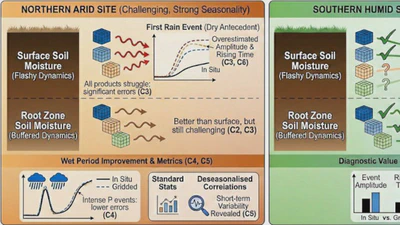
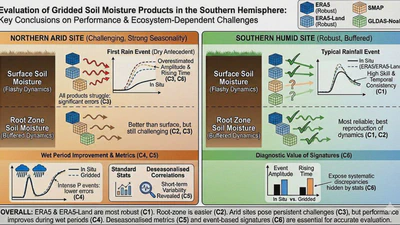
From grid to ground: how well do gridded products represent soil moisture dynamics in natural ecosystems during precipitation events?

Soil moisture (SM) is a critical variable governing land–atmosphere interactions and influencing ecohydrological and climatic processes. Despite substantial progress in estimating …

daniel-a.-nunez-ibarra

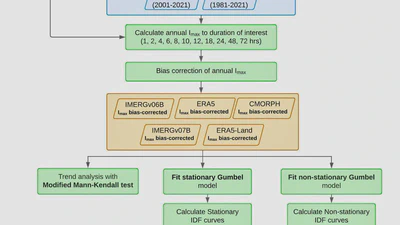
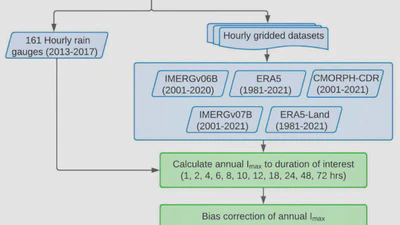
Developing Intensity-Duration-Frequency (IDF) curves using sub-daily gridded and in situ datasets: characterising precipitation extremes in a drying climate

Traditionally, Intensity-Duration-Frequency (IDF) curves are based on rain gauge data under the assumption of stationarity. However, only limited long time series of sub-daily …

cristobal-soto-escobar

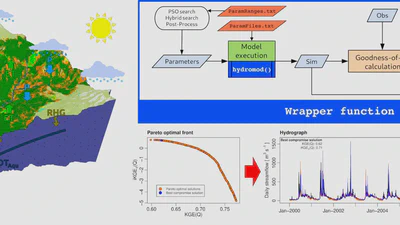
hydroMOPSO: A flexible and model-independent multi-objective optimisation R package for environmental and hydrological models

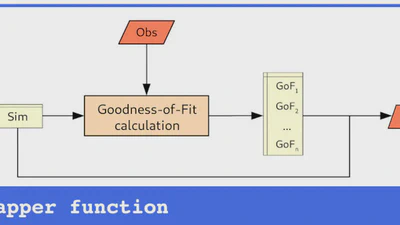
This article introduces hydroMOPSO, a multi-objective, model-independent R package for the calibration of hydrological and environmental models. It supports both R-based and …

rodrigo-marinao

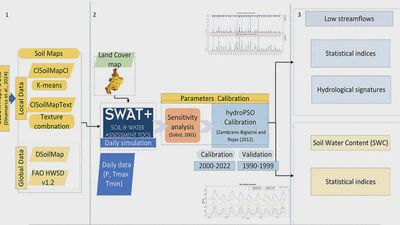
Hydropedological clustering: improving the representation of low streamflows in a semi-distributed hydrological model

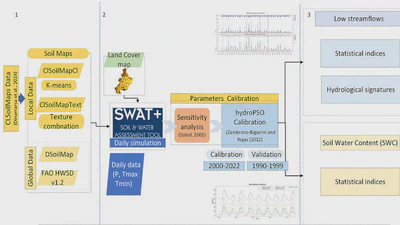
Low streamflows are critical for sustaining water supply in Mediterranean regions, yet their simulation remains challenging due to the complex influence of soils on subsurface …

fernando-gimeno
Recent Publications
(2025). Hyperdroughts in central Chile: drivers, impacts, and projections. Hydrology and Earth System Sciences.
Recent & Upcoming Talks

Create Beautiful Presentations with Markdown

Discover how to create stunning, interactive presentations using simple Markdown — no PowerPoint, Keynote, or vendor lock-in required.

avatar
Dr. Mauricio Zambrano-Bigiarini
Recent News

hydroTSM v0.8-6 on CRAN

hydroTSM v0.8-6 on CRAN

avatar
Dr. Mauricio Zambrano-Bigiarini

Article on the evaluation of gridded soil moisture products published in HESS

Article on gridded soil moisture products published in HESS

avatar
Dr. Mauricio Zambrano-Bigiarini

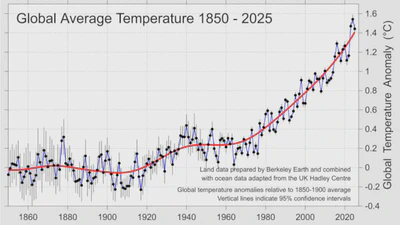
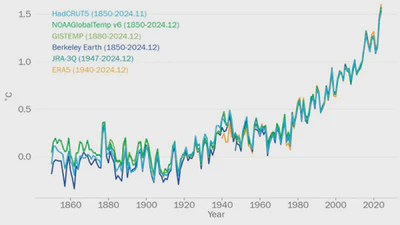
The Past 3 Years Have Been the Three Hottest

Global average temperatures in 2025 were the third hottest on record, surpassed only by 2024 and 2023

avatar
Dr. Mauricio Zambrano-Bigiarini

Article on gridded IDF curves published in HESS

Article on gridded IDF curves published in HESS

avatar
Dr. Mauricio Zambrano-Bigiarini

Article on hydroMOPSO R package published in EMS

Article on multi-objective optimisation R package published in EMS

avatar
Dr. Mauricio Zambrano-Bigiarini

Article on hydropedological clustering published in JoH

Article on hydropedological clustering published in JoH

avatar
Dr. Mauricio Zambrano-Bigiarini

WMO confirms 2024 as warmest year on record at about 1.55°C above pre-industrial level

The World Meteorological Organization (WMO) has confirmed that 2024 is the warmest year on record, based on six international datasets. The past ten years have all been in the Top …

avatar
Dr. Mauricio Zambrano-Bigiarini

Anemometer installation at the Invernada station

Anemometer installation at the Invernada station

avatar
Dr. Mauricio Zambrano-Bigiarini

Article on hydrological drought monitoring published in HESS

Article on hydrological drought monitoring published in HESS

avatar
Dr. Mauricio Zambrano-Bigiarini

2023 was the warmest year on record, (NOAA)

2023 was the warmest year on record,

avatar
Dr. Mauricio Zambrano-Bigiarini