RFmerge v0.3-3 on CRAN

In February 2023, RFmerge was removed from CRAN because we did not resolve several issues related to the retirement of rgdal and rgeos (https://r-spatial.org/r/2022/04/12/evolution.html), which were used in RFmerge 0.1-6 together with the raster package.
By July 2023, these issues were addressed, in time for a short technical course organized by SISSA. Oscar Baez-Villanueva and I delivered this course at the facilities of the Servicio Meteorológico Nacional (Argentina) from July 24 to 27, 2023. The objective was to introduce participants to the use of RFmerge for combining satellite-based precipitation products with in situ observations. A total of 15 participants attended, representing meteorological services and public institutions related to water and agriculture in Argentina, Brazil, Bolivia, Chile, Paraguay, and Uruguay.
Unfortunately, this updated version of the package (v0.2-0) was not submitted to CRAN at the time, due to time constraints affecting the development team.
A new version of RFmerge (v0.3-3) has now been released on May 8, 2026, and is available on CRAN: https://cran.r-project.org/package=RFmerge.
Key new features include:
Migration to the terra package, which supersedes raster. This represents a major change and results in a substantial improvement in computational performance.
Support for multi-core processing and distributed computing environments via the parallel package.
An updated vignette (https://doi.org/10.5281/zenodo.20061104):
Zambrano-Bigiarini, M., Baez-Villanueva, O. M., Giraldo-Osorio, J. D., & McNamara, I. (2026). Tutorial for merging satellite-based precipitation datasets with ground observations using RFmerge (>=0.3-0). Zenodo. https://doi.org/10.5281/zenodo.20061104
A new graphical logo.
A new project website built with pkgdown: http://mzb.cl/RFmerge/.
The package DOI was updated in June 2024 from the Zotero-assigned identifier to the CRAN DOI: https://doi.org/10.32614/CRAN.package.RFmerge.
A complete list of changes is available at: https://cran.r-project.org/web/packages/RFmerge/news/news.html
I hope you find this new version useful and enjoy it !
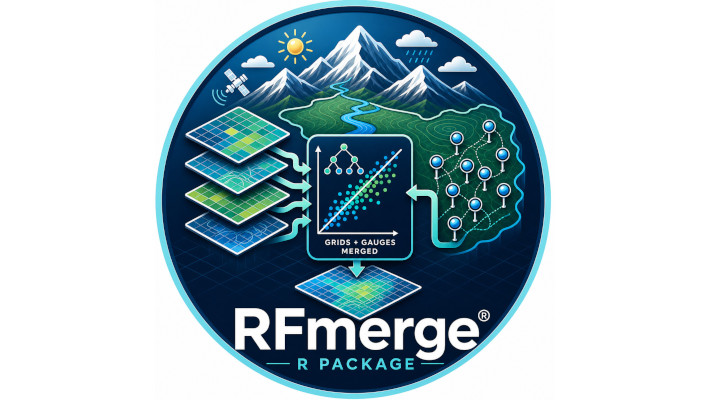
New logo of the RFmerge R package

I am an Associate Professor in the Department of Civil Engineering at Universidad de La Frontera, where I lead the Water Resources Observatory Kimün-Ko. I hold a PhD in Environmental Engineering from the University of Trento (Italy) and completed postdoctoral training at the European Commission’s Joint Research Centre.
I have more than 20 years of experience in water resources research and have previously served as an Associate Researcher at the Center for Climate and Resilience Research (CR)2 and as a member of the Earth Sciences Assessment Group of the Chilean National Research and Development Agency (ANID).
My research lies at the interface of hydrology, data science, and environmental sciences, with a particular focus on the use of gridded datasets and open-source tools to investigate droughts, extreme events, and water-related impacts of global change.
I work across spatial and temporal scales to improve the understanding of catchment-scale hydrological processes and to translate this knowledge into operational modelling, forecasting, and early-warning systems that support robust environmental decision-making.
Please reach out to collaborate 😃