Management of global change impacts on hydrological extremes by coupling remote sensing data and an interdisciplinary modelling approach (NSFC190018)
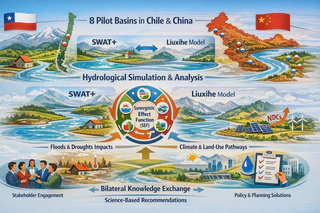 Schematic summary
Context and motivation
Climate change and rapid land-use transformation are reshaping hydrological regimes worldwide, intensifying droughts and floods while increasing pressure on already vulnerable watersheds. These challenges are particularly acute in regions where water resources sustain agriculture, forest production, hydropower, and rural livelihoods. At the same time, reservoir regulation and shifting land management practices further modify natural flow dynamics, often in ways that interact nonlinearly with climate variability. Understanding and quantifying these combined effects is therefore essential for advancing predictive hydrology and supporting adaptive water governance under global change. Within this context, this Chile–China collaborative project addresses the urgent need for integrated, process-based assessments of hydroclimatic and land-system interactions across contrasting socio-environmental settings.
Project description
This four-year research project (January December 2023) was funded by the Chilean National Agency for Research and Development (ANID) under the Concurso: Proyectos de Investigación Conjunta en Chile y China 2019 call.
This project aimed to develop and apply a comprehensive hydrological simulation framework to eight pilot basins (four in Chile and four in China) that represent diverse hydroclimatic conditions and water management challenges. Using two complementary models of different structural complexity (SWAT+ and Liuxihe) the research simulated key hydrological processes and disentangled the relative contributions of climate change, land-use change, water use, and reservoir operations over the past three decades and throughout the 21st century.
Historical reconstructions and future scenarios (including climate projections and land-use pathways aligned with policy instruments such as NDCs) were combined to assess impacts on floods and droughts. A novel Synergistic Effect Function (SEF) was proposed to quantify the compounded influence of multiple drivers.
The project further integrated stakeholder engagement in the selected basins to co-develop science-based recommendations for land-use planning and water resources management, fostering bilateral knowledge exchange and producing transferable methodologies for hydroclimatic
The outcomes of the project included:
• Reliable technological tools for representing hydrological processes in Chilean and Chinese catchments (the fully-distributed Liuxihe and the semi-distributed SWAT+ hydrological model)
• Climate, LULC, and streamflow projections for the 21st century in selected catchments.
• Assessment of catchments vulnerability to floods and droughts under global change scenarios.
• A novel calibration scheme for Liuxihe and SWAT+ models.
• A novel framework to estimate LULC during the last three decades in Chile and China.
• Evaluation of LULC and water management configurations for the 21st century, based on their impacts on water resources.
• Nature-based watershed management recommendations to mitigate the impacts of global change on water resources.

I am an Associate Professor in the Department of Civil Engineering at Universidad de La Frontera, where I lead the Water Resources Observatory Kimün-Ko. I hold a PhD in Environmental Engineering from the University of Trento (Italy) and completed postdoctoral training at the European Commission’s Joint Research Centre.
I have more than 20 years of experience in water resources research and have previously served as an Associate Researcher at the Center for Climate and Resilience Research (CR)2 and as a member of the Earth Sciences Assessment Group of the Chilean National Research and Development Agency (ANID).
My research lies at the interface of hydrology, data science, and environmental sciences, with a particular focus on the use of gridded datasets and open-source tools to investigate droughts, extreme events, and water-related impacts of global change.
I work across spatial and temporal scales to improve the understanding of catchment-scale hydrological processes and to translate this knowledge into operational modelling, forecasting, and early-warning systems that support robust environmental decision-making.
Please reach out to collaborate 😃